
Working with AI becomes much more useful when you stop treating one tool as the answer to everything. The most productive pattern is not picking one model and staying there. It is moving between models depending on what the task requires, without breaking context or wasting time every time you switch.
When switching adds friction, you test less. When you test less, you build worse.
Here are 7 workflows where that difference shows up immediately.
1.Moving from idea to product brief
Phase 1:
- Explore ideas
- Ask for approaches
- Find angles
Phase 2:
- Sort priorities
- Synthesize
- Define a first spec
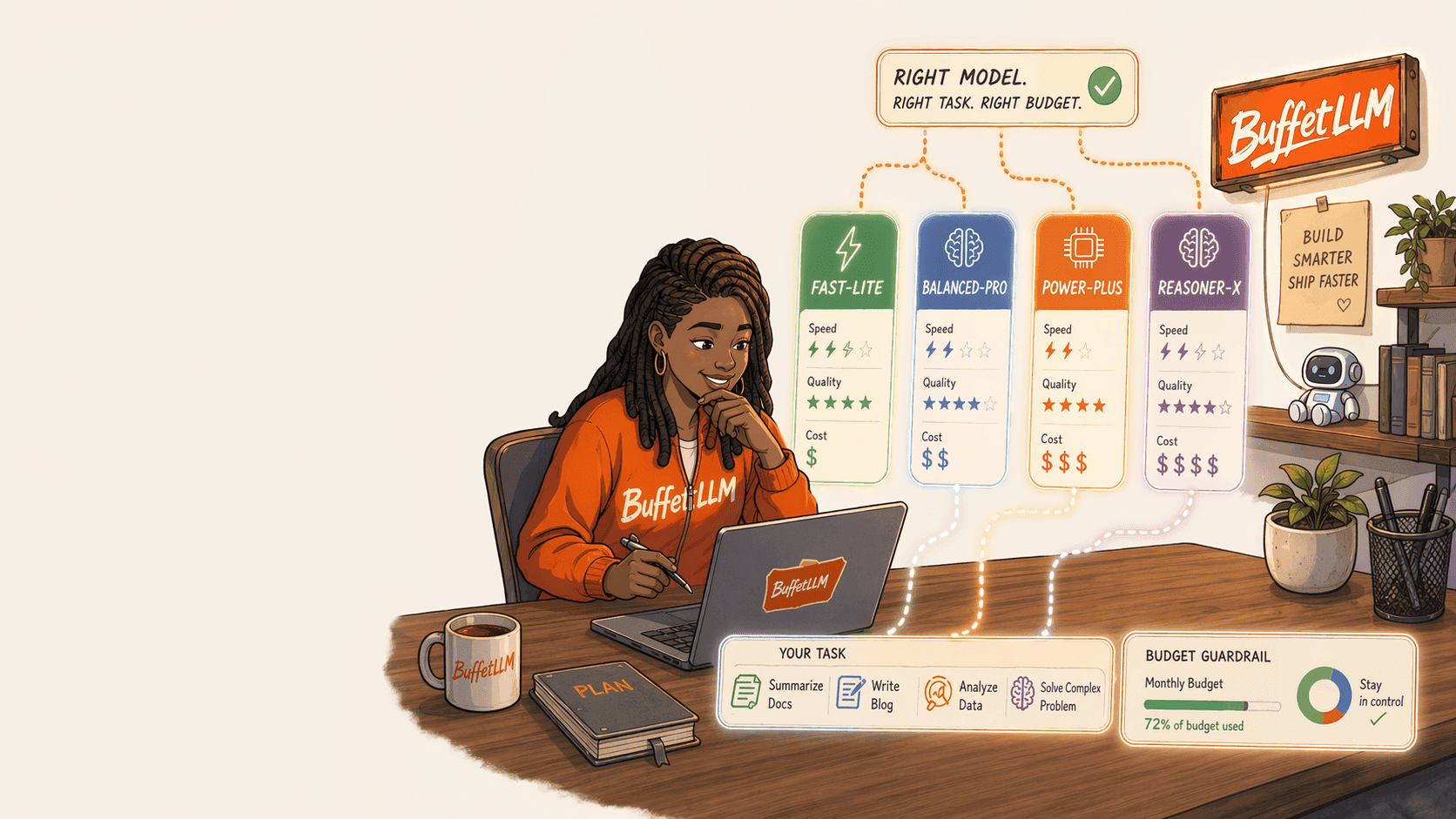
In this workflow, it rarely makes sense to use the same model for both phases. A fast, lower-cost model may work well for opening up options. A stronger one may be better for turning that mess into a usable brief.
If switching between them is awkward, you usually settle for a weaker result.
2.Coding with changing context
There are different moments inside the same coding flow:
- Understanding a codebase
- Proposing an architecture
- Solving a specific bug
- Refactoring a function
- Writing tests
Not all of these tasks demand the same thing.
A builder gains a lot when they can use one model to explore a solution and another to polish implementation details or review edge cases, without duplicating the mental work.
3.Turning raw notes into publishable content
This happens to every small team:
- Ideas in chat
- Notes in Notion
- Stray phrases
- Screenshots
- Product observations
First you need expansion and association. Then you need structure. Then you need editorial voice.
Each phase may work better with a different model profile. The problem is not technical. It is operational: if switching costs too much, many ideas never turn into posts.
4.Preparing support replies or customer answers
There are two layers here:
- Finding the correct answer
- Writing it in the right tone
Sometimes one model is better at understanding documentation or long context. Another may be better at turning that into a concise, customer-ready response.
When you can combine both without friction, support gets better. When you cannot, you usually sacrifice either precision or clarity.
5.Analyzing long documents without wasting time
A very common example:
- Upload documentation
- Ask for a summary
- Then ask for contradictions
- Then ask for implications
- Then ask for a table or checklist
That workflow is rarely linear. You iterate through it.
Switching models depending on how deep the analysis needs to go can save time and money, but only if you do not have to restart everything in another tool.
6.Designing internal automations
When you build flows to:
- Classify information
- Enrich data
- Clean text
- Summarize inputs
- Generate structured outputs
the key is separating high-value tasks from high-volume tasks.
It does not make sense to pay premium-model pricing where consistency is enough. But it may make sense to reserve stronger models for validations, exceptions, or reasoning-heavy layers.
7.Comparing outputs before deciding
One of the most valuable habits for builders is comparison.
Not because model analysis is the goal, but because some decisions change a lot when you see two different answers to the same prompt:
- A product name
- A landing page structure
- An onboarding flow
- A technical approach
Fast comparison improves team judgment. But that only happens if switching models is not penalized.
The shared pattern
The same thing happens in all 7 cases:
- The task changes
- The best model changes too
- Friction stops you from switching
- You either overpay or work worse
The bottleneck is not model quality. It is the operational cost of using models well.
What makes an AI workflow actually work
A good AI workflow does not depend on a brilliant output once in a while. It depends on three things:
- Fast iteration
- Easy comparison
- The ability to keep momentum without feeling punished for every test
If one of those is missing, AI becomes more rigid and less productive.
How BuffetLLM fits into this
At BuffetLLM, we are building from that reality: builders do not just need access to powerful models. They need to move between them with logic, less friction, and a cost structure that does not break the rhythm of their work.
Because the advantage is not access by itself. The advantage is being able to use that access better than everyone else.
Closing thought
The best AI workflows are not designed around one tool. They are designed around the real work.
When you can switch models without interrupting your process, you get more comparison, better decisions, and more iteration. In most cases, you also get a better product.
If you want to work that way, join the BuffetLLM waitlist.